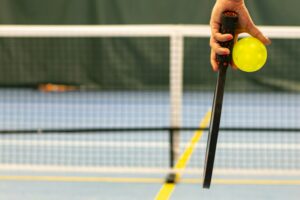
If you’ve just discovered pickleball, you’re not alone! This fun and fast-growing sport is a mix of tennis, ping pong, and badminton — and it’s easy to learn once you know the basic rules. Let’s break it down step-by-step so you can hit the court with confidence.
1. The Court and Equipment
- Court Size: 20 feet wide by 44 feet long (same for singles and doubles).
- Net Height: 36 inches at the sidelines, 34 inches in the center.
- Paddle: Solid, no strings like tennis rackets.
- Ball: A plastic perforated ball (similar to a wiffle ball).
Example: If you’ve played tennis before, think of a smaller court with a lower net and a lighter ball.
2. How to Serve
- Underhand only – paddle must make contact with the ball below your waist.
- Diagonal serve – serve cross-court into the opponent’s service box.
- One attempt – unless you hit a “let” (ball hits net and still lands in the correct box)
Example: Imagine standing behind the baseline on the right side. If it’s your turn, you aim to serve to your opponent’s right-side service box across the court (diagonally)
3. The Double-Bounce Rule
The ball must bounce once on each side before anyone can volley (hit it in the air).
- First bounce: After you serve, your opponent must let it bounce before hitting.
- Second bounce: When they return it, you must let it bounce before hitting back.
Example: You serve → they let it bounce and return → you let it bounce and hit → now volleys are allowed.
4. The Non-Volley Zone (Kitchen)
- The kitchen is the 7-foot zone on each side of the net.
- You cannot volley (hit in the air) while standing in the kitchen or touching its line.
- You can go in anytime as long as you don’t volley it (hit it out of the air) but you may hit it out of the kitchen as long as it bounces first
Example: You’re standing near the net and a high ball comes your way. If your foot is on the kitchen line when you hit it in the air, it’s a fault.

5. Scoring Rules
- Only the serving team can score.
- Games are usually played to 11 points, win by 2.
- Call the score as Server Score – Receiver Score – Server Number (1 or 2).
Example: If your team has 6 points, the other team has 3 points, and you’re the first server, you call:
“6 – 3 – 1” before serving.
6. Faults
You lose a rally (and possibly the serve) if you:
- Hit the ball out of bounds.
- Volley before the double-bounce rule is met.
- Step into the kitchen on a volley.
- Serve into the wrong area.
Example: If you smash the ball but it lands outside the court, it’s a fault.
7. A Sample Rally
- You serve diagonally from the right to your opponent’s right-side service box.
- They let it bounce, then return.
- You let it bounce, then hit it back.
- Now volleys are allowed — you and your opponent start hitting faster shots.
- Your opponent steps into the kitchen while volleying — that’s your point!
Final Tip for Beginners
Start slow. Focus on getting your serve in, respecting the double-bounce rule, and staying out of the kitchen on volleys. The more you play, the faster the rules will become second nature.